Perceptrons: An Introduction to Computational Geometry
The rigorous obituary for the single-layer perceptron — and, by overreach in its reception, a trigger of the first AI winter. It is the canonical lesson that an architecture's representational limits matter as much as its learning rule.
What · How · Why
What it is
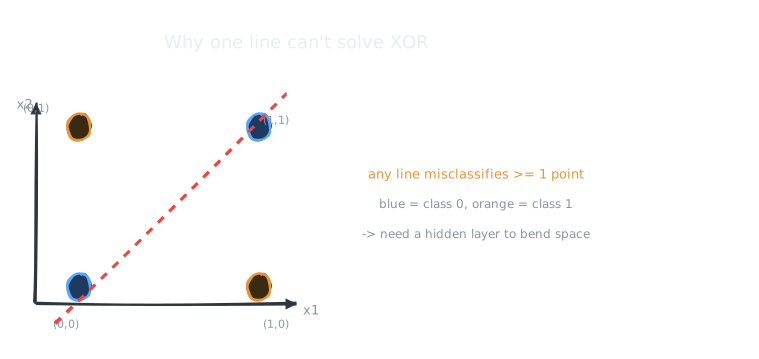
A rigorous mathematical study of what a single-layer perceptron can and cannot represent. Where Rosenblatt asked "can it learn?", Minsky & Papert ask the sharper question "what can it even express?" — and show the answer is surprisingly little, the iconic example being that it cannot compute XOR.
How it works
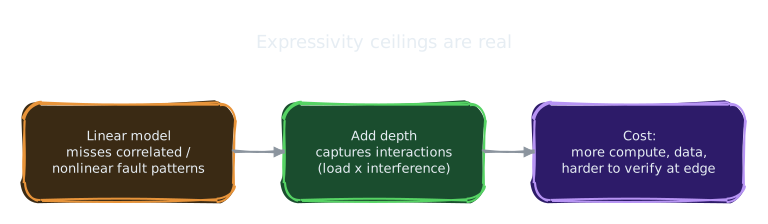
They introduce the order of a predicate — how many inputs any single feature is allowed to look at. They then prove that some natural properties need high order: parity (generalized XOR) requires a feature that sees all inputs, and deciding whether a shape is connected has unbounded order. XOR itself fails in a two-line algebraic contradiction. The fix is a hidden layer, which builds new coordinates in which XOR becomes linearly separable.
Why it matters
It established a permanent engineering habit: ask what a model class cannot represent before tuning how it learns. The book motivated depth and, by the pessimism of its reception, is widely credited with helping trigger the first AI winter. For network ML, its "order" idea explains why faults whose signatures span many cells/times are invisible to local linear models — an argument for relational or attention-based models.
Round 1 — Core Claim & Mental Model
The problem it solves
Rosenblatt's convergence theorem said the perceptron learns any separable function — but said nothing about which functions are separable. Minsky & Papert asked the sharper question: what can a perceptron represent at all, given limits on what each predicate can "see"? They answered with computational geometry, not hype.
Mental model
Think of the perceptron as a committee of local detectors feeding one linear judge. If each detector peeks at only a bounded patch of the image (limited "order"), then any global property requiring all pixels at once — like whether a shape is connected — is invisible to the committee. Locality + linearity = a hard ceiling.
Round 2 — Mathematical Model
Order of a predicate
A perceptron computes \(\psi=\big[\sum_i w_i\varphi_i(x) > \theta\big]\) where each \(\varphi_i\) depends on a subset of inputs. The order of \(\psi\) is the smallest \(k\) such that every \(\varphi_i\) reads at most \(k\) inputs.
Key impossibility results
Parity (generalized XOR over \(n\) bits) has order \(n\): it requires a predicate that sees all inputs. Connectedness of a figure is not of bounded order — no diameter-limited perceptron can decide it for arbitrarily large images.
XOR, concretely
Seek \(w_1,w_2,\theta\) with \(w_1\cdot0+w_2\cdot0\le\theta\), \(w_1+w_2\le\theta\) (the 1,1 case must be class 0), yet \(w_1\cdot1+w_2\cdot0>\theta\) and \(w_2>\theta\). Adding the two "true" inequalities gives \(w_1+w_2>2\theta\); combined with \(w_1+w_2\le\theta\) forces \(\theta<0\), contradicting \(0\le\theta\). No solution — a two-line proof.
Limiting cases
Order-1 predicates = the classic linear perceptron (XOR-blind). As allowed order \(\to n\), representational power returns but the number/size of predicates explodes — trading the linearity wall for a combinatorial one.
How It Works & Visual Diagrams
Mathematical Proofs
The book's force is a hard impossibility: a single linear threshold unit cannot compute XOR/parity. We prove that exactly, extend it to all \(n\), and state the deeper “order = \(n\)” theorem honestly as a sketch.
The fix is depth: a 2-layer net computes XOR with one hidden layer (e.g. \(x_1\oplus x_2=\mathbf 1[x_1+x_2-2\cdot\mathbf 1[x_1+x_2>1.5]>0.5]\)). Training those hidden units is precisely what backpropagation (1986) solved; the convergence guarantee it breaks is the separable-data assumption of Rosenblatt's perceptron.
Round 3 — Limitations & Community Response
What the book did not say. It analyzed single-layer perceptrons of bounded order. It did not prove multilayer networks were powerless — but its pessimistic tone was widely read that way. Hinton and others have argued the field over-interpreted it, chilling neural-net research through the 1970s.
The rebuttal arrived as an algorithm. Backpropagation (1986) plus the universal approximation theorem (Cybenko 1989, Hornik 1991) showed a single hidden layer with enough units approximates any continuous function — directly answering the representational worry. The 1988 expanded edition of Perceptrons acknowledged the multilayer developments.
Enduring validity. The specific theorems are correct and still taught; the error was sociological, not mathematical. The lasting lesson: always ask what a model class cannot represent before tuning how it learns.
Round 4 — AI × Networks Connection
AI lineage. This is the negative-space companion to the perceptron and the motivation for depth — the conceptual bridge from linear units to the deep nets behind AlexNet and the Transformer. Expressivity analysis (what a class can/can't represent) descends directly from here.
Networks angle. The order concept is a clean way to reason about feature locality in network telemetry: a fault whose signature spans many cells/time-windows (a "high-order" property) is invisible to models that only see local patches — an argument for graph/attention models over per-cell linear flags. It quantifies why ML-for-RAN sometimes needs nonlinear or relational models.
Verify — Credibility Check
The mathematical content (XOR impossibility, parity order \(=n\), connectedness unbounded order) is proved and uncontested — verifiable directly, as the two-line XOR argument above shows. What requires care is the historical claim that the book "caused" the AI winter: this is a contested narrative (funding cuts had several causes, including the 1973 Lighthill report). State the math as fact; flag the causal-history claim as a widely-held but debated interpretation. Falsification of the math would require exhibiting a single-layer order-1 perceptron computing XOR — provably impossible.
- Can "order" be operationalized for network telemetry to predict, before training, whether a fault class needs a relational/attention model rather than a per-cell classifier?
- Where is the modern analogue of the XOR wall for Transformers — what simply-stated functions do they provably fail to represent within a fixed depth/precision?
- How should the verification burden of deeper RAN models be weighed against the representational gain the order argument predicts?