Attention Is All You Need
It removed recurrence and convolution from sequence modeling and replaced them with pure self-attention. The result — the Transformer — is the architecture under GPT, BERT, and essentially every 2026 foundation model.
What · How · Why
What it is
The paper throws out the two things sequence models had always relied on — recurrence (RNNs) and convolution — and shows that attention alone is enough. The resulting architecture, the Transformer, lets every position in a sequence look at every other position directly, and it is the backbone of essentially every modern foundation model.
How it works
Each token emits a query ("what am I looking for?"), and every token offers a key ("what do I have?") and a value ("here's my content"). A token's new representation is a softmax-weighted average of all values, weighted by how well its query matches each key — a differentiable, content-addressed lookup. This runs for all positions in parallel (no waiting for the previous step) and across multiple "heads" that attend to different relations at once; since attention ignores order, position is added back via positional encodings.
Why it matters
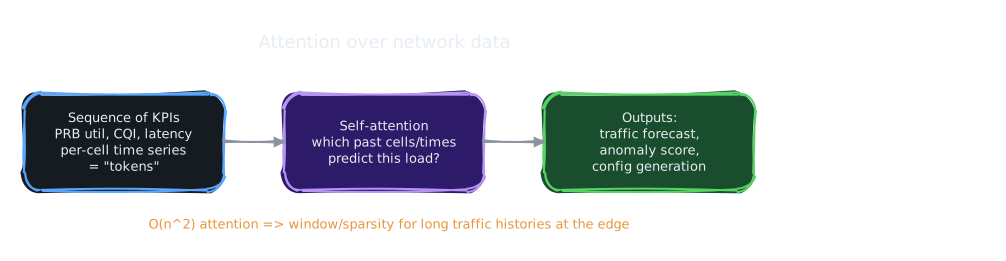
Removing the serial dependency means training scales with GPU parallelism instead of sequence length — the property that made today's LLMs possible. For AI × Networks, network KPIs are sequences too, so self-attention now drives traffic prediction, anomaly detection, and config generation; the catch is its O(n²) cost, which collides head-on with edge latency and memory budgets.
Round 1 — Core Claim & Mental Model
The problem it solves
RNNs/LSTMs process a sequence step by step: token \(t\) cannot be computed until \(t-1\) is done. That serial dependency caps GPU utilization and erodes long-range signal through many sequential transforms. The claim: attention alone, with no recurrence, suffices — and because every position is computed in parallel, training scales with hardware instead of sequence length.
Mental model
Each token broadcasts a query ("what am I looking for?"), and every token offers a key ("what do I have?") and a value ("here's my content"). A token's new representation is a weighted average of all values, weighted by query–key match. Every word looks at every other word in one shot — a fully-connected, content-addressed lookup rather than a conveyor belt.
What would be true if the paper is right
A non-recurrent model should match or beat RNNs on translation while training far faster, and the architecture should scale cleanly with data and parameters. Both held — and the scaling property is what made the LLM era possible.
Round 2 — Mathematical Model
Scaled dot-product attention
\[ \mathrm{Attention}(Q,K,V)=\mathrm{softmax}\!\left(\frac{QK^{\top}}{\sqrt{d_k}}\right)V \]\(Q\in\mathbb{R}^{n\times d_k}\), \(K\in\mathbb{R}^{n\times d_k}\), \(V\in\mathbb{R}^{n\times d_v}\). The \(\sqrt{d_k}\) scaling counteracts dot-products growing like \(d_k\): without it, softmax saturates into near-one-hot and gradients vanish. With unit-variance entries, \(q\cdot k\) has variance \(d_k\), so dividing by \(\sqrt{d_k}\) restores unit variance.
Multi-head attention
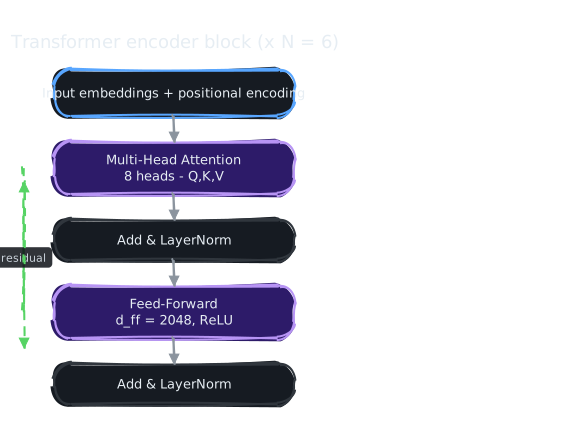
\[ \mathrm{head}_i=\mathrm{Attention}(QW_i^Q,KW_i^K,VW_i^V) \] \[ \mathrm{MHA}=\mathrm{Concat}(\mathrm{head}_1,\dots,\mathrm{head}_h)\,W^O \]\(h\) heads (8 in the base model) run attention in parallel subspaces of width \(d_k=d_{\text{model}}/h=64\), letting the model attend to different relations (syntax, coreference, position) simultaneously, then recombine.
Positional encoding
Attention is permutation-equivariant — it has no notion of order — so order is injected additively:
\[ PE_{(pos,2i)}=\sin\!\big(pos/10000^{2i/d}\big),\quad PE_{(pos,2i+1)}=\cos\!\big(pos/10000^{2i/d}\big) \]Complexity analysis
Self-attention is \(O(n^2\,d)\) time and \(O(n^2)\) memory for the attention matrix (every pair of the \(n\) tokens interacts), but only \(O(1)\) sequential steps — the whole layer is one big matmul. An RNN is \(O(n\,d^2)\) time but \(O(n)\) sequential steps. The Transformer trades more FLOPs for far more parallelism: a win when \(n Attention rows are convex combinations (softmax ⇒ non-negative weights summing to 1): the output lives in the convex hull of the values. Without positional encoding the model is fully order-blind. As \(n\to\infty\), \(O(n^2)\) memory dominates — the entire motivation for sparse/linear-attention successors. With one head and identity projections it reduces to a single soft lookup.Invariants & limiting cases
How It Works & Visual Diagrams
Mathematical Proofs
Three properties make scaled dot-product attention work and explain its quirks: the \(\sqrt{d_k}\) scaling is forced by a variance calculation, the output is a convex combination of values (bounded, contractive), and self-attention is permutation-equivariant — which is exactly why positional encodings are mandatory.
Cross-links: the variance argument is the same softmax-saturation concern as in backprop's vanishing gradients; the order-blindness motif connects to Lamport (when is order even defined?). For networks, permutation-equivariance argues for topology-aware (not sequential) positional encodings on RAN data — see traffic prediction.
Round 3 — Limitations & Community Response
Quadratic cost. \(O(n^2)\) in time and memory is the central limitation. A wave of successors attacks it: Sparse/Longformer/BigBird (sparse patterns), Linformer/Performer (low-rank / kernel linear attention), and — crucially for deployment — FlashAttention (2022), which doesn't change the math but makes it IO-aware, the single biggest reason long contexts became practical.
Data hunger & weak inductive bias. With no built-in locality (unlike CNNs) or recurrence, Transformers need large data or heavy augmentation to generalize — vivid in vision (ViT underperforms CNNs on small datasets). The bias-free design that hurts at small scale is exactly what lets it dominate at large scale.
What it left open. The paper was about translation; the authors did not anticipate scaling laws or emergent in-context learning. Those were empirical discoveries on top of the architecture (Kaplan 2020; Brown 2020) — the Transformer was necessary but the LLM story is downstream. Sinusoidal positions were also quickly superseded by learned, relative, and rotary (RoPE) encodings.
Round 4 — AI × Networks Connection
Direct intersection use. Network KPIs are sequences; self-attention is now a leading approach for traffic prediction, RAN anomaly detection, and LLM-based network configuration generation — all three are intersection-domain backlog items this node feeds. The associative-lookup mental model maps cleanly: "which prior cells/time-windows best explain this cell's current load?"
The deployment tension. The \(O(n^2)\) wall collides head-on with edge-inference latency/memory budgets — connecting this paper to KV-cache mechanics and inference-at-the-edge. Whether a Transformer fits a fronthaul latency budget is a concrete, unresolved engineering question, and a direct descendant of Shannon's rate–latency trade.
Lineage. Self-attention is content-addressable computation built on the Universal Machine (Turing); training minimizes cross-entropy, i.e. optimal source coding (Shannon). This node ties the two foundational papers to the modern intersection.
Verify — Credibility Check
Headline results (confirmed against the paper): big model reaches 28.4 BLEU on WMT'14 EN→DE (state-of-the-art at publication, >2 BLEU over prior) and 41.8 BLEU on EN→FR, trained 3.5 days on 8 NVIDIA P100 GPUs — a small fraction of the compute prior SOTA used, which is the paper's efficiency claim. Base model ≈ 65M parameters (\(d_{\text{model}}=512\), \(N=6\), \(h=8\)), big ≈ 213M. Plausibility: the numbers are independently reproduced thousands of times; the architecture is the most-replicated result in modern ML, so credibility is overwhelming. The one experiment that "validated" it beyond the paper was the entire field re-running it — and scaling it 10⁵×. (Note: one widely-shared web summary mis-states base params as 165M; the paper's Table 3 gives 65M.)
- Can a sub-quadratic attention variant hold accuracy on long network-KPI histories and fit an edge latency budget — or is the \(n^2\) blend fundamentally what makes it work?
- Does the permutation-equivariance of attention need a network-specific positional encoding (topology-aware rather than sequential) for RAN data?
- If training is optimal source coding, is a traffic-prediction Transformer implicitly estimating the entropy rate of the network — and does that give a Shannon-style lower bound on prediction error?