Learning Representations by Back-Propagating Errors
The paper that made deep networks trainable: it showed how to assign credit to hidden units via the chain rule, learning internal representations automatically. It is the algorithm every modern model — CNNs, Transformers, diffusion — is optimized with.
What · How · Why
What it is
The method that finally made deep networks trainable. The open problem since Minsky was: a hidden unit has no "correct answer" to aim at, so how do you know which way to adjust its weights? Backpropagation answers by computing exactly how much each weight contributed to the final error.
How it works
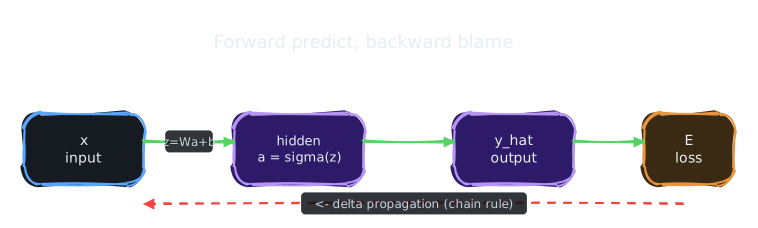
A forward pass computes the prediction and its error. Then the error is propagated backward through the network using the chain rule: each layer passes its "blame signal" to the layer below, scaled by the connecting weights. One backward sweep yields the gradient for every weight at once (this is reverse-mode automatic differentiation), costing the same order as the forward pass — \(O(W)\) — instead of perturbing each weight separately. Gradient descent then steps the weights downhill.
Why it matters
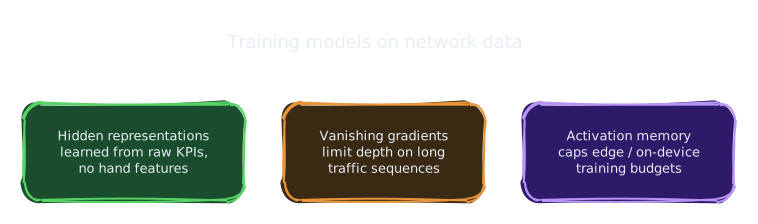
It is the optimizer behind every model in this KB — AlexNet, the Transformer, GPT-3 are all trained by it — and the literal answer to Minsky & Papert: depth becomes learnable, so representational power returns. Its two costs (gradients that vanish with depth, and the memory needed to cache activations) are precisely what bound how deep a model you can train on-device or at the RAN edge.
Round 1 — Core Claim & Mental Model
The problem it solves
Minsky & Papert's wall was that one layer can't represent XOR; multilayer nets can, but nobody had a practical way to train the hidden layers — what target should a hidden unit aim for? Backprop answers: there is no explicit target; instead, propagate the output error backward to compute each weight's responsibility for it.
Mental model
Blame assignment in a chain of command. The output layer made an error; backprop distributes blame proportionally to how much each upstream unit contributed, layer by layer, using the chain rule. Forward pass = predict; backward pass = "who is responsible, and by how much?"
Round 2 — Mathematical Model
Setup
Layer \(l\): \(z^{(l)} = W^{(l)}a^{(l-1)} + b^{(l)}\), \(a^{(l)}=\sigma(z^{(l)})\). Loss \(E\) (e.g. squared error or cross-entropy).
The four backprop equations
\[ \delta^{(L)} = \nabla_a E \,\odot\, \sigma'(z^{(L)}) \] \[ \delta^{(l)} = \big((W^{(l+1)})^{\top}\delta^{(l+1)}\big)\,\odot\,\sigma'(z^{(l)}) \] \[ \frac{\partial E}{\partial W^{(l)}} = \delta^{(l)} (a^{(l-1)})^{\top},\qquad \frac{\partial E}{\partial b^{(l)}} = \delta^{(l)} \]where \(\odot\) is elementwise product. \(\delta^{(l)}\) is the "error signal" at layer \(l\); the recursion (eq. 2) is the chain rule made systematic.
Derivation sketch
By the chain rule, \(\partial E/\partial z^{(l)}_j = \sum_k (\partial E/\partial z^{(l+1)}_k)(\partial z^{(l+1)}_k/\partial z^{(l)}_j)\). Since \(z^{(l+1)}_k=\sum_j W^{(l+1)}_{kj}\sigma(z^{(l)}_j)+b\), the inner derivative is \(W^{(l+1)}_{kj}\sigma'(z^{(l)}_j)\) — giving exactly eq. (2). Update: \(W \leftarrow W - \eta\,\partial E/\partial W\).
Complexity
One backward pass costs the same order as the forward pass: \(O(W)\) in the number of weights — this efficiency (vs \(O(W^2)\) naive) is the whole point. Memory: must cache activations \(a^{(l)}\) from the forward pass, \(O(\sum_l |a^{(l)}|)\) — the origin of activation-memory pressure in deep training.
Invariants & limiting cases
Invariant: backprop computes the exact gradient (it is reverse-mode autodiff), not an approximation. Limiting cases: linear \(\sigma\) collapses any depth to a single linear map (depth wasted). Saturating \(\sigma\) (sigmoid/tanh) drives \(\sigma'\to 0\), so \(\delta\) shrinks geometrically with depth — the vanishing gradient that stalled deep nets until ReLU and normalization.
How It Works & Visual Diagrams
Mathematical Proofs
Backpropagation is the chain rule organized as a backward recursion so that all partial derivatives are computed in a single pass. We derive the four equations from scratch and then prove the property Round 3 weaponizes: gradients are a product of Jacobians, so they vanish or explode geometrically in depth.
- Output layer. \(a^{(L)}_j=\sigma(z^{(L)}_j)\) depends on \(z^{(L)}_j\) only, so \(\displaystyle \delta^{(L)}_j=\frac{\partial E}{\partial z^{(L)}_j}=\frac{\partial E}{\partial a^{(L)}_j}\frac{\partial a^{(L)}_j}{\partial z^{(L)}_j}=(\nabla_aE)_j\,\sigma'(z^{(L)}_j).\)
- Recursion. The only path from \(z^{(l)}_j\) to \(E\) is through layer \(l{+}1\): \(z^{(l+1)}_k=\sum_j W^{(l+1)}_{kj}\sigma(z^{(l)}_j)+b^{(l+1)}_k\). By the multivariable chain rule, \[ \delta^{(l)}_j=\sum_k \frac{\partial E}{\partial z^{(l+1)}_k}\frac{\partial z^{(l+1)}_k}{\partial z^{(l)}_j}=\sum_k \delta^{(l+1)}_k\,W^{(l+1)}_{kj}\,\sigma'(z^{(l)}_j), \] which is \(\big((W^{(l+1)})^{\top}\delta^{(l+1)}\big)\odot\sigma'(z^{(l)})\) in vector form.
- Parameter gradients. Since \(z^{(l)}_j=\sum_i W^{(l)}_{ji}a^{(l-1)}_i+b^{(l)}_j\), we have \(\partial z^{(l)}_j/\partial W^{(l)}_{ji}=a^{(l-1)}_i\) and \(\partial z^{(l)}_j/\partial b^{(l)}_j=1\). Therefore \(\partial E/\partial W^{(l)}_{ji}=\delta^{(l)}_j a^{(l-1)}_i\) (outer product) and \(\partial E/\partial b^{(l)}_j=\delta^{(l)}_j\). ∎
Cross-links: this is the training engine behind every node downstream — AlexNet (ReLU defeats the \(\tfrac14\) factor), the Transformer (residuals + LayerNorm keep the Jacobian product near \(1\)). The forward/backward duality is itself reverse-mode automatic differentiation.
Round 3 — Limitations & Community Response
Vanishing/exploding gradients. With saturating activations the error signal decays or blows up exponentially in depth — the practical barrier that kept nets shallow until ReLU (2010s), careful init (Glorot/He), batch/layer norm, and residual connections. The 1986 method was correct but the ecosystem to make it work deep took 25 years.
Local minima / non-convexity & biological implausibility. The loss is non-convex; backprop finds local optima (now understood to be benign at scale). It also requires symmetric weight transport and a separate backward phase, which is hard to reconcile with neuroscience — spawning alternatives (feedback alignment, target propagation, forward-forward).
Priority debate. Reverse-mode differentiation predates the paper (Linnainmaa 1970; Werbos 1974 applied it to nets). The 1986 paper's contribution was demonstrating it learns useful internal representations and popularizing it — credit is shared, a point Schmidhuber has pressed publicly.
Round 4 — AI × Networks Connection
AI lineage (central node). Backprop is the optimizer for every later AI paper in this KB — AlexNet and the Transformer are trained by it. It is the literal answer to Minsky & Papert: depth becomes learnable, so representation is recovered. This node connects the early-NN papers to the deep-learning era.
Networks angle. Its costs define the feasibility of ML-for-RAN: vanishing gradients limit how much history a traffic model can backprop through (motivating attention/LSTM choices), and cached-activation memory is the gating constraint for any on-device or edge fine-tuning — directly tied to inference-at-the-edge tradeoffs.
Verify — Credibility Check
Backprop is exact reverse-mode autodiff — verifiable by finite-difference gradient checking, the standard sanity test: \(\partial E/\partial w \approx (E(w+\epsilon)-E(w-\epsilon))/2\epsilon\) should match to ~6 digits. The mathematics is uncontested. What needs honest framing is credit: the algorithm is older than 1986; this paper's claim is empirical (it learns good hidden features, e.g. their family-tree and symmetry-detection demos) plus expository, and that claim has been reproduced at planetary scale. Falsification would require a gradient-check mismatch — which only ever surfaces as an implementation bug, never a flaw in the method.
- For edge RAN, do backprop-free or memory-light training schemes (forward-forward, local learning) ever beat the activation-memory cost of true backprop at acceptable accuracy?
- How deep can a traffic-prediction model backprop through time before vanishing gradients force an attention/state-space alternative?
- If gradients are exact, what does the geometry of the RAN loss landscape (many benign minima vs sharp ones) imply for the robustness of deployed models to distribution shift?