ImageNet Classification with Deep Convolutional Neural Networks
"AlexNet" — the result that ignited the deep-learning era. By training a deep CNN on GPUs with ReLU and dropout, it cut ImageNet top-5 error from 26.2% to 15.3%, ending the hand-engineered-feature paradigm in computer vision overnight.
What · How · Why
What it is
"AlexNet" — the deep convolutional network that won the 2012 ImageNet competition by a stunning margin and ended the era of hand-engineered image features. It is the empirical result that converted the field to deep learning almost overnight.
How it works
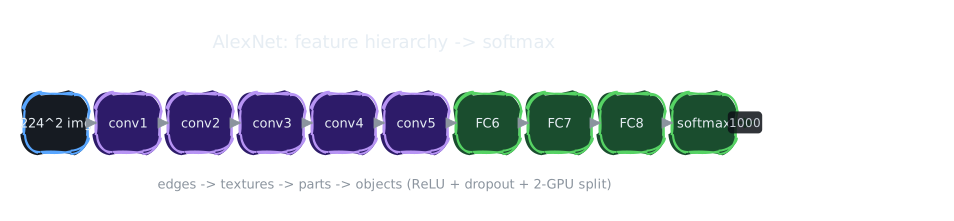
It stacks learned convolutional filters that build a hierarchy — early layers detect edges and colors, middle layers textures and parts, late layers whole objects — all trained end-to-end by backpropagation. The breakthrough was making this work deep: ReLU activations (which don't saturate, so gradients survive), dropout (randomly disabling units to prevent a 60-million-parameter net from memorizing), data augmentation, and splitting training across two GPUs to fit in memory.
Why it matters
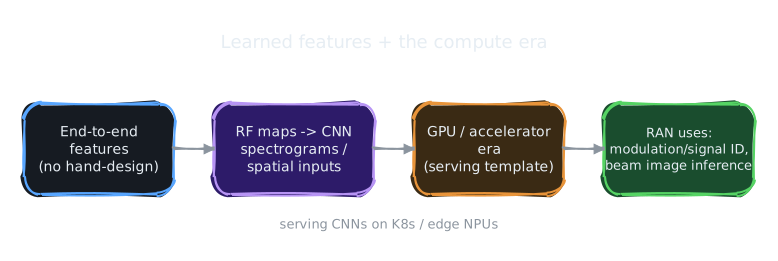
It ignited the deep-learning era and the GPU-for-AI economy, and established the recipe — deep network + big data + accelerators + regularization — that the Transformer would later scale. It also set the deployment template you work in: serving deep models on GPUs/edge NPUs, now used for RF/PHY tasks like modulation and signal classification from spectrograms.
Round 1 — Core Claim & Mental Model
The problem it solves
Until 2012, image recognition meant hand-crafted features (SIFT, HOG) + a shallow classifier. The claim: a deep CNN, given enough data (ImageNet, 1.2M images) and compute (GPUs), learns better features end-to-end than humans can design — if you solve the practical training obstacles.
Mental model
A hierarchy of learned filters. Early layers detect edges and color blobs; middle layers compose them into textures and parts; late layers assemble parts into objects. Convolution = the same small filter slid everywhere (translation-equivariance + weight sharing), so the net learns "edge detector" once and reuses it across the image.
Round 2 — Mathematical Model
Convolution layer
\[ y_{i,j,k} = \sigma\!\Big( b_k + \sum_{c}\sum_{u,v} W_{u,v,c,k}\,x_{\,i+u,\,j+v,\,c} \Big) \]Filter \(W\) of size \(f\times f\times C\) produces feature map \(k\); shared across all positions \((i,j)\).
The key ingredients
ReLU: \(\sigma(z)=\max(0,z)\). Non-saturating, so gradients don't vanish — they report ~6× faster convergence than tanh. Dropout: randomly zero hidden units with prob 0.5 at train time, \(\approx\) averaging an exponential ensemble — the main regularizer for the 60M-parameter net. Local response normalization and overlapping max-pooling add competition and small translation invariance.
Architecture & size
5 convolutional + 3 fully-connected layers, ~60M parameters and ~650K neurons, ending in a 1000-way softmax. Trained split across two GPUs (3GB each) — an early model-parallelism necessity, not a choice.
Complexity
Conv cost per layer: \(O(H\,W\,C_{\text{in}}\,C_{\text{out}}\,f^2)\) — dominated by spatial size × channels × kernel area. Weight sharing makes parameter count tiny relative to a fully-connected equivalent (a key reason it fit in memory), but FLOPs stay high — the GPU was essential. Inference is feed-forward \(O(\text{FLOPs})\).
Invariants & limiting cases
Convolution is translation-equivariant by construction (shift input ⇒ shift feature map). Limiting cases: \(1\times1\) filters reduce to per-pixel MLPs (channel mixing only); remove pooling and the receptive field grows only linearly with depth; remove dropout and the 60M-param net overfits 1.2M images badly — the authors report dropout was essential.
How It Works & Visual Diagrams
Mathematical Proofs
AlexNet has no single theorem; its power comes from three structural choices, each of which admits a clean formal statement: convolution is translation-equivariant (and parameter-thrifty), ReLU removes the gradient-killing factor of backprop, and dropout is an expectation over an exponential ensemble.
Cross-links: equivariance and weight-sharing make CNNs the deployment template for RF signal/modulation classification and spatial RAN inference on edge NPUs; the ReLU result is the practical unlock of backpropagation, and the same residual/normalization toolkit reappears in the Transformer.
Round 3 — Limitations & Community Response
Data- and compute-hungry; weak priors beyond translation. AlexNet needed 1.2M labels and GPU weeks. CNNs encode translation but not rotation/scale invariance, and are notoriously brittle to adversarial perturbations and distribution shift — vulnerabilities discovered shortly after (Szegedy 2013).
Rapid supersession. The architecture was quickly improved: VGG (deeper, smaller filters), GoogLeNet/Inception, and especially ResNet (2015), whose residual connections enabled 100+ layers and pushed ImageNet error below human level. AlexNet is historically pivotal but architecturally obsolete.
Reception. The single most important empirical result in modern AI's takeoff — it converted the field to deep learning and triggered the GPU-for-AI economy. Critiques target generalization and robustness, not the headline result, which has been reproduced exhaustively.
Round 4 — AI × Networks Connection
AI lineage. AlexNet is backprop (1986) finally working at scale, and the proof-of-concept that made the Transformer's scaling bet credible five years later. It established the modern recipe: deep net + big data + accelerators + regularization. It connects the early-NN papers to the foundation-model era.
Networks angle. CNNs are now standard for RF/PHY tasks — modulation classification, signal/interference identification, and treating spectrograms or spatial beam patterns as images. Just as important, AlexNet set the deployment template you work in: serving deep models on GPUs/edge NPUs, with the latency/throughput tradeoffs that dominate inference-at-the-edge for RAN.
Verify — Credibility Check
Headline numbers (confirmed): ILSVRC-2012 top-5 error 15.3% vs the next-best 26.2% — a ~10.9-point gap, unprecedented in the competition's history; ~60M parameters, 650K neurons, 5 conv + 3 FC layers, trained on two GTX 580 GPUs. Plausibility is unimpeachable: the result was won live in a public benchmark, code/weights were released, and it has been reimplemented thousands of times. The single experiment that validated it was the ImageNet leaderboard itself; the field's immediate pivot to deep learning is the strongest possible external confirmation.
- For RF/PHY tasks, do convolutional priors (translation equivariance) actually match the symmetries of spectrogram/IQ data, or do attention/SSM models fit RAN signals better?
- What is the right accelerator/quantization point to serve a CNN classifier inside a RAN latency budget — and how does that compare to the AlexNet-era GPU template?
- Given CNN adversarial brittleness, how robust must a deployed RF classifier be to deliberate interference, and does that change the architecture choice?