Time, Clocks, and the Ordering of Events in a Distributed System
The founding paper of distributed systems theory. It showed that "what happened first" in a network has no absolute answer — only a partial order defined by causality — and gave the logical-clock algorithm that underpins every consistent distributed system since.
What · How · Why
What it is
The founding paper of distributed-systems theory. Its core realization is that in a system of separate machines with no shared clock, the question "did event A happen before event B?" has no absolute answer — the only ordering the system can truly observe is causality.
How it works
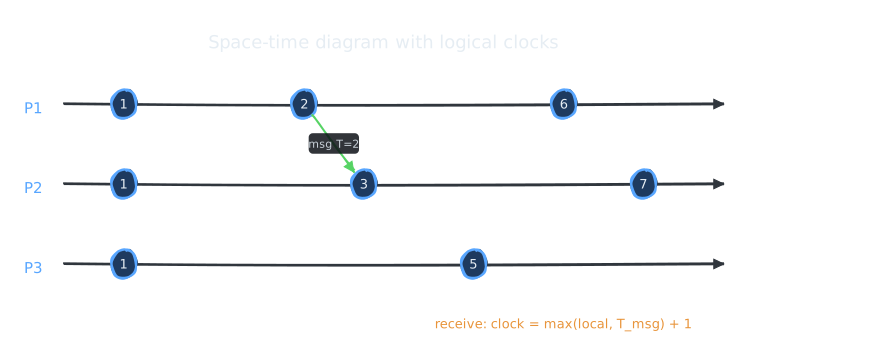
Lamport defines "happens-before": A precedes B if they're in the same process in that order, or A sends a message that B receives, plus transitivity. He then gives logical clocks — simple counters — that respect this: each process ticks on every event, and a message receiver jumps its counter past the sender's timestamp (\(C \leftarrow \max(C, T_{msg})+1\)). Breaking ties by process ID yields a global total order, which he uses to build distributed mutual exclusion and state-machine replication (keep every replica applying the same commands in the same order, and they stay identical).
Why it matters
This is how distributed databases, 5G cores, O-RAN control planes, and your own K8s/etcd backend stay consistent without a global clock — Paxos and Raft are its direct descendants. For AI × Networks, happens-before is also the right lens for reasoning about staleness when gradient updates arrive out of order in asynchronous and federated learning across edge nodes.
Round 1 — Core Claim & Mental Model
The problem it solves
In a distributed system there is no shared global clock; physical clocks drift and messages take variable time. So "did event A happen before event B?" is ill-posed across machines. Lamport's insight: replace physical time with causality — the only ordering the system can actually observe.
Mental model
An event can influence another only if information could have flowed between them: within one process (program order) or via a message (send before receive). That "could-have-influenced" relation is happens-before, a partial order. Concurrent events are simply those neither could affect — and the system is free to order them however it likes.
Round 2 — Mathematical Model
Happens-before (\(\to\))
The smallest relation such that: (1) if \(a\) precedes \(b\) in the same process, \(a\to b\); (2) if \(a\) is a send and \(b\) its receive, \(a\to b\); (3) transitivity. If neither \(a\to b\) nor \(b\to a\), they are concurrent (\(a\,\|\,b\)). It is a strict partial order (irreflexive + transitive).
Logical clock condition
Assign each event a counter \(C(e)\) satisfying the Clock Condition:
\[ a \to b \;\Rightarrow\; C(a) < C(b) \]Note the implication is one-way: \(C(a)
The algorithm (IR1/IR2)
IR1: each process increments its counter before every event. IR2: a message carries its send timestamp \(T_m\); on receipt the receiver sets \(C \leftarrow \max(C, T_m) + 1\). Break ties by process ID to get a total order \(\Rightarrow\) consistent with \(\to\).
Application: distributed mutual exclusion & state machines
Using the total order, Lamport builds a fair mutual-exclusion protocol and the state-machine replication principle: if every replica applies the same commands in the same total order, they stay identical. This is the conceptual seed of Paxos and Raft.
Complexity & limits
Scalar clock: \(O(1)\) space per process, one integer per message — cheap, which is why it is ubiquitous. The limit: it loses the ability to test concurrency; vector clocks pay \(O(n)\) space to recover \(a\to b \Leftrightarrow V(a)
How It Works & Visual Diagrams
Mathematical Proofs
Lamport replaces physical time with a causal order. The results: happens-before is a strict partial order (no causal loops), logical clocks respect it, and a tie-broken total order extends it — which is exactly what makes state-machine replication correct.
Cross-links: “when is order even defined?” is the dual of the order-blindness of self-attention in the Transformer; causal staleness bounds underpin asynchronous federated learning across RAN nodes, where updates from different workers are concurrent events that must be merged consistently.
Round 3 — Limitations & Community Response
Scalar clocks can't detect concurrency. The one-way implication means equal/ordered counters don't tell you whether two events were causally related — a real problem for conflict detection. Vector clocks (Fidge, Mattern 1988) and version vectors fix this at \(O(n)\) cost; they are the direct descendants.
Failure model. The 1978 protocols assume reliable messaging and non-faulty processes. Real systems crash and lie, which spawned the Byzantine line (Lamport's own 1982 Byzantine Generals) and consensus under failure (Paxos 1998, Raft 2014). The FLP impossibility (1985) later showed deterministic consensus is impossible in a purely asynchronous network with even one crash — a hard limit this paper's optimism predates.
Reception. Universally foundational; one of the most cited papers in CS and the work most associated with Lamport's 2013 Turing Award. The critique is not of correctness but of scope — it is the calm base case on which the failure-tolerant superstructure was built.
Round 4 — AI × Networks Connection
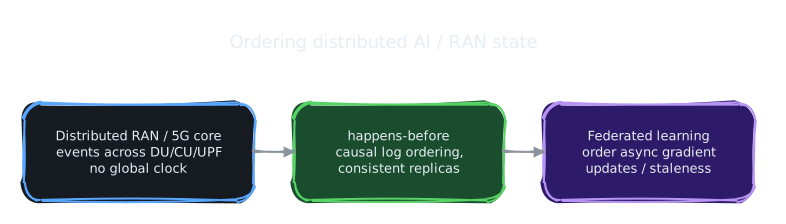
Networks angle (strongest in the KB so far for distributed systems). Modern 5G cores and O-RAN control planes are distributed systems: state spread across DU/CU/UPF/RIC with no global clock. Causal ordering and state-machine replication are exactly how their databases and controllers stay consistent. Your C++/K8s backend work sits squarely on this foundation — etcd (Raft) is a Lamport descendant.
AI angle. Asynchronous and federated learning across edge nodes face the same ordering problem: gradient updates arrive out of order with variable staleness. Happens-before is the right lens for bounding staleness and reasoning about convergence of async SGD — connecting distributed-systems theory to distributed ML.
Verify — Credibility Check
The results are theorems with full proofs (the Clock Condition construction, the mutual-exclusion protocol's safety/liveness). They have been formally specified and model-checked countless times — Lamport himself created TLA+ partly to verify such protocols. Credibility is total. The one experiment that would "break" it — a consistent distributed system that violates causal ordering yet stays correct — is impossible by construction, since correctness is defined relative to the causal order. The scope caveats (no failures, scalar clocks lose concurrency info) are acknowledged limits, not errors.
- For O-RAN's near-real-time RIC (sub-10ms control loops), where is the boundary between needing causal consistency and tolerating eventual consistency for ML-driven decisions?
- Can staleness bounds expressed in happens-before terms give convergence guarantees for federated learning across heterogeneous-latency RAN edges?
- Does the FLP impossibility impose a fundamental floor on how fast a fault-tolerant distributed RAN controller can react — and is that floor ever the binding latency constraint?