The Anatomy of a Large-Scale Hypertextual Web Search Engine
The paper behind Google. Its core idea — PageRank — turns the web's link graph into a ranking by computing the stationary distribution of a random surfer. It is the canonical example of extracting signal from graph structure, the seed of graph-based ML.
What · How · Why
What it is
The paper behind Google. Its key idea, PageRank, scores a web page's importance not from its text but from the structure of links pointing to it — a link is a vote, and votes from important pages count more. More broadly, it is the canonical recipe for extracting signal from a graph's shape.
How it works
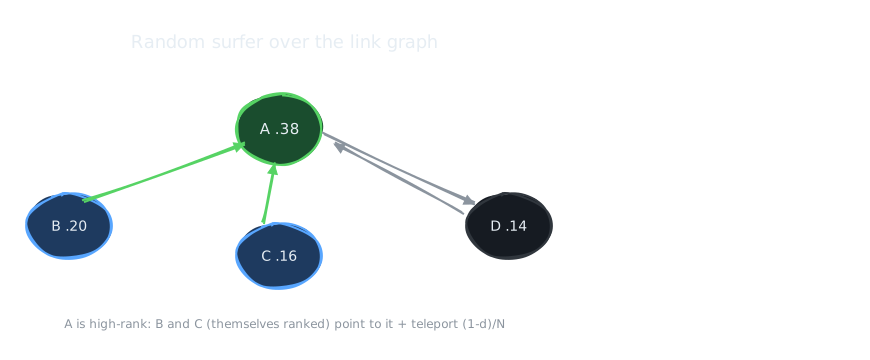
Imagine a "random surfer" who clicks links forever and occasionally teleports to a random page. A page's PageRank is the fraction of time the surfer spends there — formally the dominant eigenvector of the "Google matrix," or the stationary distribution of a Markov chain. The teleport term (damping ≈ 0.85) is what guarantees a unique answer and handles dead-ends. It's computed by power iteration: repeatedly multiply the rank vector by the sparse link matrix, costing \(O(\text{edges})\) per step and converging in ~100 iterations.
Why it matters
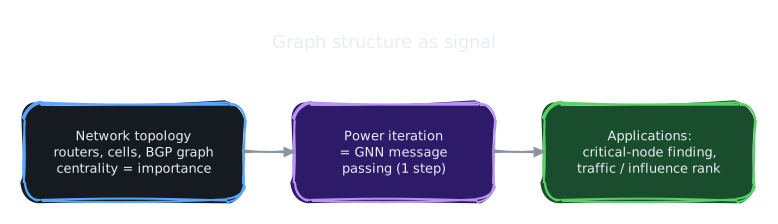
Beyond reshaping the web, PageRank is the intellectual ancestor of Graph Neural Networks — one power-iteration step is exactly one round of graph message passing. For networks it is a direct tool: rank the most critical routers/links in a topology (failure-impact analysis) or the most influential nodes in a BGP/AS graph, using the same sparse-matrix primitive.
Round 1 — Core Claim & Mental Model
The problem it solves
1990s search ranked by on-page text, which was easy to spam and ignored authority. Brin & Page's claim: a page's importance is encoded in the link graph — a link is a vote, and votes from important pages count more. Rank emerges from global graph structure, not page content alone.
Mental model
Imagine a surfer clicking links at random forever, occasionally teleporting to a random page (with probability \(1-d\)). The fraction of time spent on each page = its PageRank. Important pages are those the surfer keeps returning to. It is a recursive definition: you're important if important pages point to you.
Round 2 — Mathematical Model
The PageRank equation
\[ PR(p_i) = \frac{1-d}{N} + d\sum_{p_j \in B_i} \frac{PR(p_j)}{L(p_j)} \]\(B_i\) = pages linking to \(p_i\), \(L(p_j)\) = out-degree of \(p_j\), \(d\approx 0.85\) the damping factor, \(N\) total pages.
Matrix form — a stationary distribution
\[ \mathbf{r} = \Big(d\,M + \tfrac{1-d}{N}\mathbf{1}\mathbf{1}^{\top}\Big)\mathbf{r} = G\mathbf{r} \]\(M\) is the column-stochastic link matrix; \(G\) is the "Google matrix." PageRank \(\mathbf r\) is the dominant eigenvector of \(G\) (eigenvalue 1) — equivalently the stationary distribution of a Markov chain.
Why it's well-defined (Perron–Frobenius)
The teleport term makes \(G\) stochastic, irreducible, and aperiodic, so by Perron–Frobenius a unique positive stationary vector exists and power iteration converges to it. Damping is not a hack — it is what guarantees existence and uniqueness, and it handles dangling nodes (no out-links).
Computation & complexity
\[ \mathbf{r}^{(k+1)} = G\,\mathbf{r}^{(k)} \]Power iteration: each step is a sparse mat-vec, \(O(\text{edges})\) — linear in links, not \(N^2\), because \(M\) is sparse (avg out-degree ~ small constant). Convergence rate set by the second eigenvalue \(|\lambda_2|\le d\), so error shrinks like \(d^k\); ~50–100 iterations suffice for the whole web. Space: \(O(N+\text{edges})\).
Limiting cases
\(d\to 1\): pure link-following — convergence slows and dangling/sink nodes trap rank. \(d\to 0\): uniform ranking (links ignored). \(d=0.85\) is the empirical sweet spot. A disconnected graph without teleport would have no unique stationary vector — exactly what damping repairs.
How It Works & Visual Diagrams
Mathematical Proofs
PageRank is the stationary distribution of a random surfer. Two facts make it well-posed and fast: the Google matrix has a unique dominant eigenvector (Perron–Frobenius), and power iteration converges geometrically with rate exactly the damping factor \(d\).
Cross-links: one step \(\mathbf r\mapsto G\mathbf r\) is a round of graph message passing — the conceptual ancestor of GNNs; the same spectral-gap argument governs mixing of Markov chains used in network reliability and load models. Damping \(d\) trades convergence speed (smaller \(d\)) against fidelity to the true link structure (larger \(d\)).
Round 3 — Limitations & Community Response
Gameable & static. Pure PageRank invited link farms and spam; Google layered hundreds of signals (anchor text, TrustRank, later learning-to-rank and BERT) on top. Query-independence is also a weakness — topic-sensitive and personalized PageRank (Haveliwala 2002) added context.
Scale & freshness. The 1998 system indexed ~24M pages; the web grew by orders of magnitude, demanding incremental/streaming PageRank and distributed computation (the paper helped motivate MapReduce). Convergence on an evolving graph is itself a research area.
Reception. Foundational and commercially world-changing. Mathematically it's a clean Markov-chain/eigenvector result; the critiques are about adversarial robustness and the gap between "importance" and "relevance," not correctness.
Round 4 — AI × Networks Connection
Networks angle. PageRank is centrality on a graph — directly applicable to network topologies: ranking critical routers/links (failure-impact analysis), identifying influential cells, or scoring nodes in a BGP/AS graph. Power iteration over a sparse adjacency is the same primitive used in network analytics.
AI angle (the bridge to graph ML). One PageRank step = one round of graph message passing; PageRank is the intellectual ancestor of Graph Neural Networks (and explicitly revived in APPNP, "PageRank-based propagation"). It is the cleanest entry point to the GNN node in the AI domain. It also shares Shannon's spirit: extracting structure from a stochastic process's stationary behavior.
Verify — Credibility Check
The math is a textbook Markov-chain result: existence/uniqueness follow from Perron–Frobenius given the damping-induced irreducibility and aperiodicity — provable, not empirical. Sanity check the convergence claim: with \(d=0.85\), error \(\sim 0.85^k\); reaching \(10^{-6}\) needs \(k\approx \log(10^{-6})/\log(0.85)\approx 85\) iterations — matching the "~100 iterations for the whole web" folklore. The commercial result (Google's relevance) is empirical and overwhelmingly validated. Falsification would be a connected, damped web graph with no unique stationary vector — impossible under Perron–Frobenius.
- Does PageRank-style centrality predict failure impact in RAN/transport topologies better than degree or betweenness — and is it cheap enough to recompute online as the topology changes?
- If attention is a soft, learned graph and PageRank a fixed one, what does personalized PageRank tell us about good positional/topology encodings for network Transformers?
- How does convergence degrade on rapidly-evolving network graphs, and is there a streaming approximation with bounded error suitable for near-real-time control?